Late last night, I completed reading the new "Star Trek" novel, "Crucible: Spock: The Fire and the Rose". It's Part Two of a trilogy, and looking almost as chunky as its giant predecessor, ("
Crucible: McCoy"). Although a "mere" 390 pages, this was another thoroughly enjoyable read.
This time, the events stretch from the second "Star Trek" pilot, "Where No Man Has Gone Before", and spends quite a bit of time delving into new scenes to complement several crucial time travel episodes: the death of Kirk's love, Edith Keeler, in "The City on the Edge of Forever"; the story of young Spock's practice-run of his
kahs-wan ordeal in the animated episode, "Yesteryear"; and the retrieval of humpback whales in ST IV. All three were highly popular adventures in their day, the events of which took their toll on poor ol' emotion-suppressing Spock.
We learn in this volume that Spock carries a deep and secret pain. While he saved his mother's and his own lives in "Yesteryear", via time travel, and saved the whole Earth in ST IV, again via time travel, Spock had previously chosen not to lend a hand to his best friend, Kirk, when they discovered that Edith had to die to enable them to rebuild the timeline. Although it's not spelled out, you do find yourself wondering if Edith could have been brought through time, as marine biologist Gillian Taylor (ST IV) had been, if only Spock's logic was not clouded by emotion. (Or vice versa.)
The book takes Spock beyond ST VI, through his new career as a diplomat, a new love affair - and the tragic "death" of Kirk in "Generations". Spock also makes a second attempt to eradicate his emotions with the
Kolinahr discipline, which he first tried - and failed - to do in ST:TMP... until Vejur, a gigantic sentient machine, made mental contact with him from deep space.
Many times I found myself deliberately reading slower, as if I was trying to make the book last longer. David George also has a knack of having his characters mull over certain facts at irregular intervals, sometimes making different observations each time, and I found it a very realistic exploration of people with deep problems. Problems that have no easy resolution. I was also often quite aware of how the story had been constructed - but I don't say this as a criticism. Mr George was retreading old ground with this book - ST stories we knew so well, and also he was essentially retelling aspects of the recent "McCoy" volume - so it was fascinating - to steal a Spock term - to predict what elements of the ST tapestry were about to be woven into the mystery.
Again, the "Crucible" trilogy purposely works within its own continuity, as regarding other ST novels, but it still leaves some wriggle room - and sets up parameters - for events that won't occur until later: the novels featuring the courtship and marriage of Spock and Saavik; and Spock's attempts to reunify Vulcan and Romulus in "Unification (TNG).
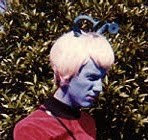
And, once again, Filmation's animated ST series of the 70s (TAS) is well represented in some great references: Paul Bates is back, but this time so is Loom Aleek-Om the Aurelian, Jan Grey the historian, Thelin the Andorian, Erikson, Arex, Dawson Walking Bear, Carver, Gabler, the Terratins (and Verdanis and Cepheus), a Pandronian artist, Governor Bob Wesley (and Mantilles), I-Chaya the
sehlat, the
le-matya, life-support belts, Lunaport, Shi'Kahr, Vulcan's Forge and the L-Langon Mountains, young Spock's Cousin Selek and his
Tasmeen visit,
and even a rare mention of the kzinti Treaty of Sirius. (Late additions: Questar M17, Rigel II and Amanda's surname of Grayson.) Wow, thanks David George!
I spent most of today updating my
Toon Trek pages and my
Lower Decks novel pages again to include all the new "Crucible" TAS references.
Now I can't wait for the upcoming "Kirk" instalment...






 Posts
Posts