Showing posts with label Crucible. Show all posts

Monday, December 10, 2007

A novel argument

Over at TrekBBS, the old chestnut of stand-alone versus serialized Star Trek novels has again arisen.

Some fans seem to yearn for simpler times, when they never feel tempted to read beyond one tie-in product to truly get the gist of one particular adventure. They don't want any sharing of original characters, which essentially puts an end to any continuing characters past the credited headlining stars of a series. Some have speculated that Pocket Books is no longer soliciting manuscripts that tell self-contained Star Trek stories.

Of course they do! Happens often enough. There's no ban on stand-alone adventures at all. I take it some are not enjoying some of the so-called "relaunches" and serialized stories, even though the authors seem (to me) to tell a complete story within their instalment. A great recent example is the "Crucible" trilogy by David R George III. The first one, "McCoy", is totally stand-alone, even to its trilogy mates, if one so chooses.

First-time authors following Pocket's official ST submission policy must submit a stand-alone novel that makes no reference to existing novels. (Mind you, that's to prove that they can write in the genre, and can follow guidelines.) But even in the supposedly "good old days" of the 1980s, a stand-alone novel could become so successful that it spawned a sequel. So one might say that today's readers would be hesitant to pick up AC Crispin's "Time for Yesterday" if they hadn't already read "Yesterday's Son" - but neither the editor nor author knew that the first adventure would extend beyond one book. The first ST novel I ever read was Bantam's "The Fate of the Phoenix", a sequel to "The Price of the Phoenix"!

I say, trust the authors to make every ST novel as stand-alone as possible - which they do! There are very few novels, except perhaps a few early duologies and trilogies that were designed as duologies or trilogies, that can't stand alone.

Many readers also don't want any novels to ever conflict with another. And that becomes harder and harder to achieve every month. I recently chatted with a high school student who has to write a science fiction short story for an assignment, and he wants to imply that it is part of an arc of stories that might eventually lead to a novel. It's essential, for the assignment, that the short story actually also be self-contained.

You know, I've met many Star Trek fans over the years who seem to be always looking for a chance to opt out of something, ie. so they have an excuse not to read/see it. "Oh, this novel requires a knowledge of the one ST film I hate so I won't be reading that one." "I heard that book had too many unexplained in-jokes." "The books aren't canonical, so I refuse to read them." "I only read novels written by people who have direct connections to canonical ST". Etc.

If readers truly want stand-alone ST stories, then they are going to conflict with all the others. We also end up with hundreds - thousands! - of interesting guest crew characters who never get to grow beyond one story. A volume of "The Best of Trek" had an article where somebody tried to do a definitive list of original Enterprise crewmembers who had appeared in the novels. Initally I was excited as I remembered there'd been a small amount of character sharing and sequeling in the Bantam and early Pocket novels (Dr Ruth Rigel, Ingrit Thomson, Mahase the Eseriot, Naraht the Horta, Harb Tanzer, Lia Burke, etc), but the resulting list seemed totally useless and pointless, since most other characters received one appearance only - and often it was for a redshirt whose entire contribution to the plot was "Please sign this" or "Aaaargghhh!".

And whenever an author decided to make use of minor TOS guest crew, such as Freeman ("The Trouble With Tribbles"), they'd give him a different first name anyway. I can't see why some readers say they lack of character-building across novels something to celebrate? If an author tried to give every character in his/her ST novel equal time to get a story arc happening for them, and each arc completed in the one novel, most of it would be described by most readers as "wasted filler". The arcs they complete in a single novel ultimately contribute to the plot of that novel. Also, the authors would eventually exhaust the 420 or so TOS crew, or the 1000 or so TNG crew in just a few years of novels, because some readers say they don't want any minor characters ever being shared between books.

Minor characters don't have to have a story arc at all, of course - that's why they are minor characters - but if a new author can add a dimension to a few of them in some future novel, that's good. But you still don't have to read every instalment to get resolution of the major arcs of the first novel. It's an Easter egg for those who notice it.
DuaneTrek

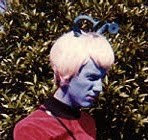
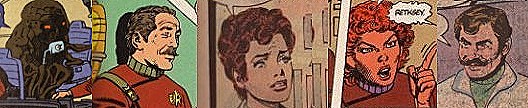
For example, we learn a tiny bit more about hortas each time Naraht (above left) appears in a novel. (I guess you don't want to know that he's also popped up in a computer game and a few comics, and each time we learned more about the oddities of silicon-based life.)

Referring to JJ Abrams' upcoming TOS movie, they say, "An ambitious and risk taking studio would be making a new space opera, instead of remaking Trek."

Sorry, I don't want "a new space opera". I want more Star Trek, and the thought of a new TOS adventure, where the characters are all young and virile again, is very exciting.

I was also asked, "Have you ever invested in something, be it books, music, movies, TV, whatever, that you collected eagerly as it was being released, experienced it once at the time of purchase, then never looked at it again? Did that collection wind up in a yard/car boot sale twelve months later?"

Nope, not really. But even if I did only see/read/hold it the once (and a lot of my books await unread), it was the buying of it that had some exhilaration, and was probably worth the price of purchase. A bit like seeing a live stage show. I usually buy the souvenir program, but the memories of going to and seeing the actual performance is what I paid the initial ticket price for. I could live without the program, I guess, but it's handy for later reference.

If they do all end up in a car boot sale or eBay someday when I'm 90, so be it. I've had a lifetime of memories from the initial outlays of money. But I agree, any collection you choose to stop adding to eventually risks falling from grace, and the collector must go in search of new thrills. Human nature. Enjoy it!

Sunday, August 12, 2007

Brisbane Sci-Nut Convention: Sunday 2nd Sept!

On a whim, I've decided I'm going to the one-day Brisbane Sci-Nut Convention on Sunday 2nd September! (Mmmm. Happy Father's Day, Dad - but you can't have that bag of black jellybeans until I get to Perth in October.)

Guests include Jack Donner (Romulan Subcommander Tal, of the original "Star Trek" episode, "The Enterprise Incident" and the Vulcan Priest from several episodes of "Enterprise"), David R George III (Trek novelist, who wrote the recent "Crucible" trilogy and co-wrote "The 34th Rule"), Dragon Dronet (props & weapons) and Wanda Piety (costumes, modules and miniatures). Mr George is a last-minute switch for Susan Shwartz. For bookings, use the convention's online ticketing agent, Water Sprite Pty Ltd.

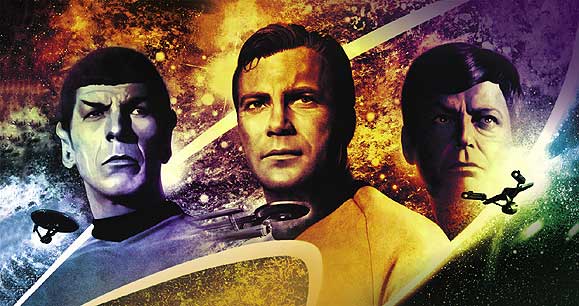
Crucible: triptych cover
David R George III, author of "Crucible" is coming!
(Triptych cover art by John Picacio)

The same convention runs in Canberra the previous Sunday (26th August), the day after the Sydney Star Trek Meet-up has scheduled its first picnic - but I already have accommodation in Brisbane, visiting my friends Peter and Maria, and their new baby, Benjamin (who hopefully won't already be walking before I get there. Babies grow up too quickly these days!).

I hope to see some familiar Sydney faces there, plus the regular ConQuest crowd, since ConQuest itself isn't running until November this year!

Sunday's mystery number: 96.1, sighing with relief.

Sunday, April 22, 2007

One more time: into the crucible!

I selected four Star Trek books to take on vacation with me. I had only a few pages to go on the latest "Enterprise" novel, "The Good That Men Do". I also had Book 2 of "Errand of Fury" ("Demands of Honor"), plus... the third and final "Vulcan's Soul" book ("Epiphany") which came in the day before I left.

But, as soon as the "Enterprise" book was finished (more on that one later) it was straight into the surprisingly slim David R George III novel, "Crucible: Kirk: The Star to Every Wandering". It's Part Three of a trilogy, the first two instalments of which were mighty meaty reads (ie. "Crucible: McCoy").

This time, George goes for the unexpected, and much of the story revolves around Kirk's Nexus encounter in "Generations", opposite Antonia, Guinan and Picard, rather Edith and "The City of the Edge of Forever".

Once again, the author pays homage to many episodes of TOS. Across the three volumes, he ensures that every episode gets at least one reference each. Filmation's animated ST series of the 70s (TAS) is also well represented: the S.S. Huron, helmeted Orions, the magical planet of Megas-Tu, Lieutenant Anne Nored (only an ensign yet, passed in the corridor), life support belts, a tribble-eating glommer, and a street named for Robert T April! Across the three volumes, David George ensures that every TAS episode also gets at least one reference each. I spent today updating my Toon Trek pages and my Lower Decks novel pages yet again. It now includes many more "Crucible" TAS references.

Now I can't wait to see if David George is going to tackle the exciting seven-year mission he postulates for Kirk and the Enterprise in "Crucible", which fits between ST:TMP and ST II.

I'm happy to recommend the "Crucible" trilogy to any Star Trek fan hungry for new insights into Kirk, Spock and McCoy.

Saturday, January 13, 2007

Again, wallowing in the crucible

Late last night, I completed reading the new "Star Trek" novel, "Crucible: Spock: The Fire and the Rose". It's Part Two of a trilogy, and looking almost as chunky as its giant predecessor, ("Crucible: McCoy"). Although a "mere" 390 pages, this was another thoroughly enjoyable read.
This time, the events stretch from the second "Star Trek" pilot, "Where No Man Has Gone Before", and spends quite a bit of time delving into new scenes to complement several crucial time travel episodes: the death of Kirk's love, Edith Keeler, in "The City on the Edge of Forever"; the story of young Spock's practice-run of his kahs-wan ordeal in the animated episode, "Yesteryear"; and the retrieval of humpback whales in ST IV. All three were highly popular adventures in their day, the events of which took their toll on poor ol' emotion-suppressing Spock.

We learn in this volume that Spock carries a deep and secret pain. While he saved his mother's and his own lives in "Yesteryear", via time travel, and saved the whole Earth in ST IV, again via time travel, Spock had previously chosen not to lend a hand to his best friend, Kirk, when they discovered that Edith had to die to enable them to rebuild the timeline. Although it's not spelled out, you do find yourself wondering if Edith could have been brought through time, as marine biologist Gillian Taylor (ST IV) had been, if only Spock's logic was not clouded by emotion. (Or vice versa.)

The book takes Spock beyond ST VI, through his new career as a diplomat, a new love affair - and the tragic "death" of Kirk in "Generations". Spock also makes a second attempt to eradicate his emotions with the Kolinahr discipline, which he first tried - and failed - to do in ST:TMP... until Vejur, a gigantic sentient machine, made mental contact with him from deep space.

Many times I found myself deliberately reading slower, as if I was trying to make the book last longer. David George also has a knack of having his characters mull over certain facts at irregular intervals, sometimes making different observations each time, and I found it a very realistic exploration of people with deep problems. Problems that have no easy resolution. I was also often quite aware of how the story had been constructed - but I don't say this as a criticism. Mr George was retreading old ground with this book - ST stories we knew so well, and also he was essentially retelling aspects of the recent "McCoy" volume - so it was fascinating - to steal a Spock term - to predict what elements of the ST tapestry were about to be woven into the mystery.

Again, the "Crucible" trilogy purposely works within its own continuity, as regarding other ST novels, but it still leaves some wriggle room - and sets up parameters - for events that won't occur until later: the novels featuring the courtship and marriage of Spock and Saavik; and Spock's attempts to reunify Vulcan and Romulus in "Unification (TNG).

And, once again, Filmation's animated ST series of the 70s (TAS) is well represented in some great references: Paul Bates is back, but this time so is Loom Aleek-Om the Aurelian, Jan Grey the historian, Thelin the Andorian, Erikson, Arex, Dawson Walking Bear, Carver, Gabler, the Terratins (and Verdanis and Cepheus), a Pandronian artist, Governor Bob Wesley (and Mantilles), I-Chaya the sehlat, the le-matya, life-support belts, Lunaport, Shi'Kahr, Vulcan's Forge and the L-Langon Mountains, young Spock's Cousin Selek and his Tasmeen visit, and even a rare mention of the kzinti Treaty of Sirius. (Late additions: Questar M17, Rigel II and Amanda's surname of Grayson.) Wow, thanks David George!
I spent most of today updating my Toon Trek pages and my Lower Decks novel pages again to include all the new "Crucible" TAS references.

Now I can't wait for the upcoming "Kirk" instalment...

Wednesday, October 11, 2006

Wallowing in the crucible

A "Star Trek" novel, "Crucible: McCoy: Provenance of Shadows" was my vacation reading of choice last week. 628 pages, on super slim paper to keep the chunkiness to a minimum, it was indeed an excellent selection!

I was staying with some old ST friends in Brisbane, in sunny Queensland. The sun was up at 5.15am every day, light streaming into my room. Nothing else to do but read, until the household was awake for breakfast. One of my hosts is also about to give birth to her first child and needed lots of naps, so I had David R George III's literary company, off and on, for a whole week. I got totally sucked into the universe that is "Star Trek: Crucible", greedily sneaking off for extra chapters at every opportunity.

The events stretch from the end of "The City on the Edge of Forever", one of the most popular TOS episodes, until several years after retired Admiral McCoy's visit to Picard's Enterprise in "Encounter at Farpoint" (the premiere episode of "The Next Generation"). Even though the "Crucible" trilogy purposely works in its own continuity, as regarding other ST novels, it seemed to me that David George purposely worded his description of the Enterprise's return from "Out there, thataway" (in ST:TMP) to include wiggle room for a recent and popular novel set in that time period, "Ex Machina".

That Filmation's animated ST series of the 70s (TAS) is so well referenced was a delight to me! Many more aspects than I expected: first names for (Paul) Bates and (Jimmy) Clayton, welcome cameo appearances by Randi Bryce and M'Ress the Caitian, and cheeky references to Mantilles, Dramia II, Edoans, Phylosians, Vedala, Aquan surgo-ops and even practical joking computers!

I'm very curious how much the upcoming "Spock" and "Kirk" instalments of this new trilogy will intersect the "McCoy" novel, and how much will focus on new events, and events barely hinted at in "McCoy". The three covers will make a triptych mural, too. A very cool 40th anniversary event!
Captain's Log, Supplemental: Too cool. Over on TrekBBS, David R George responded to my review thusly.

I've just spent the morning updating my Toon Trek pages to include all the "Crucible" TAS references.